

Why Verbal Agreements Are Not Enough to Protect Your Business
Photography contracts are essential for protecting your business from misunderstandings and disputes. Many photographers rely on verbal agreements early on, especially with referrals or repeat clients. While that trust may feel sufficient, it rarely holds up when expectations differ. Verbal promises leave too much open to interpretation, and interpretation is exactly what causes disputes.
It is easy to understand why photographers skip contracts with clients they already trust. A referral or a repeat client feels like a safe bet. But trust and clarity are two different things, and even the most trustworthy client can genuinely remember a conversation differently than you do.
Verbal Agreements Rely on Memory, Not Clarity
Verbal agreements depend on both parties remembering details the same way. In reality, clients and photographers often recall conversations differently. Small details can be forgotten or misunderstood, whether that is the number of edited images included, the length of coverage, or the delivery timeline. When that happens, there is no reference point to fall back on.
Without written documentation, photographers are left vulnerable. Even well intentioned clients may dispute timelines, deliverables, or pricing, not out of dishonesty, but because their memory of the conversation genuinely differs from yours. Verbal agreements provide no clear protection. Clarity must be documented to be enforceable.
Common Issues Verbal Agreements Create
Verbal agreements often fail when expectations change. Clients may request additional edits, longer coverage, or faster delivery than what was originally discussed. Without written terms, it becomes difficult to say no without feeling like you are the one going back on your word. This can lead to frustration on both sides.
Payment disputes are also common. Without agreed upon payment terms, clients may delay or question invoices, sometimes genuinely unaware that a deposit or balance was expected by a certain date. Verbal discussions rarely outline consequences for late payments. This puts photographers in an uncomfortable position, forced to either enforce a term that was never written down or let it go and absorb the loss.

Why Contracts Create Professional Boundaries
Written photography contracts establish clear boundaries. They outline what is included, what is not, and how changes are handled if a client wants something beyond the original scope. Clients understand expectations upfront. This reduces conflict later, because there is a shared reference point instead of two competing memories.
Contracts also signal professionalism. Clients feel reassured knowing there is a clear agreement in place, the same way they would expect from any established business. That reassurance builds trust. Trust leads to smoother working relationships, because both sides know exactly where they stand from the beginning.
Legal Protection Matters More Than You Think
Contracts are not just about conflict prevention. They also provide legal protection if issues escalate beyond a simple disagreement. Courts rely on written agreements, not conversations. Verbal agreements are difficult to prove, and difficult to enforce, even when you are clearly in the right.
Even simple contracts are better than none. Clear language protects both parties, not just the photographer. Protection gives photographers peace of mind. Peace of mind allows you to focus on your work instead of worrying about what might happen if a client pushes back on something you thought was already settled.
How Iris Works Supports Contract Automation
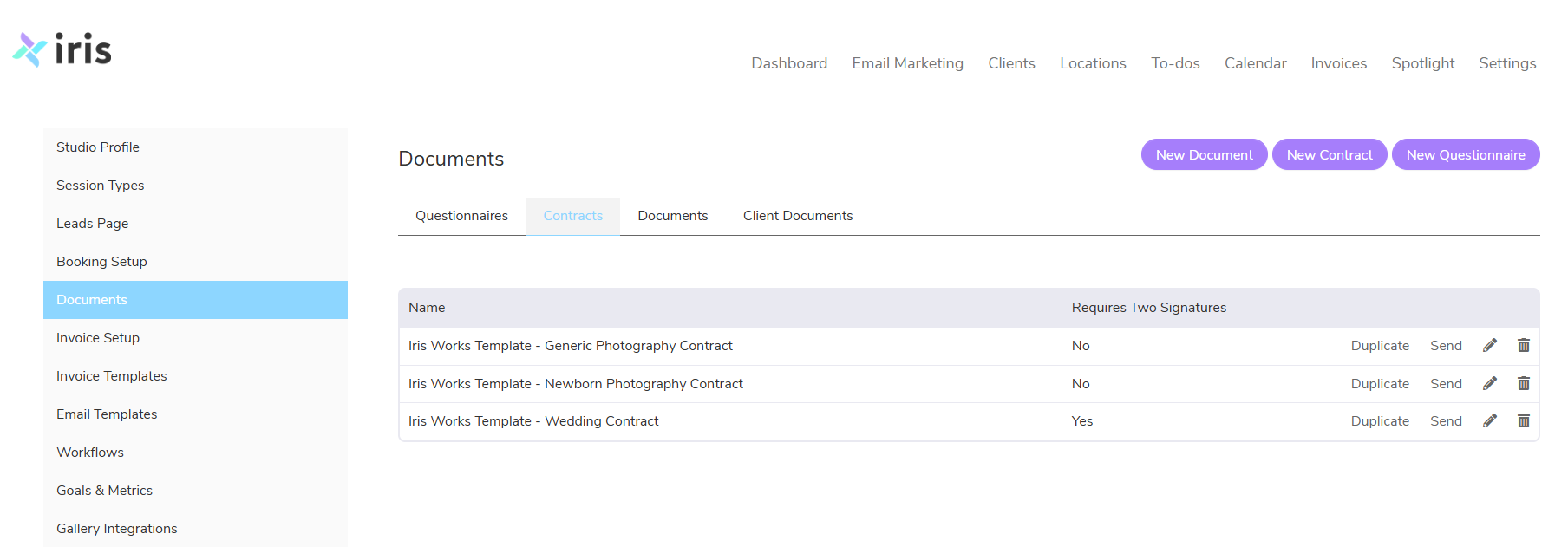
Using Iris Works, photographers can create and send photography contracts automatically. Contracts are tied directly to bookings, so there is no separate step to remember or manage. Clients review and sign digitally before moving forward. This ensures nothing is missed.
Automated contracts remove awkward follow up. Photographers do not have to chase signatures or send reminder emails hoping a client gets around to it. Everything is tracked and stored in one place. Organization improves across the business, and there is always a clear record of what was agreed to.
Contracts Improve the Entire Client Experience
Clients appreciate knowing exactly what they are agreeing to. Transparency builds confidence. Confidence reduces tension. Clear contracts lead to smoother projects, because both sides are working from the same understanding instead of assumptions.
When photographers rely on photography contracts instead of verbal promises, their business becomes more stable.
Expectations are aligned early. Disputes decrease. Professionalism increases, and that stability carries through every part of the working relationship that follows.
Frequently Asked Questions
How does Iris Works help photographers send contracts without relying on verbal agreements?
Iris Works allows photographers to create contracts that are tied directly to a booking, so a written agreement is part of the process automatically instead of depending on a separate conversation that might be remembered differently later.
Can Iris Works help ensure clients sign a contract before a session takes place?
Yes. With Iris Works, clients can review and sign contracts digitally as part of the booking flow, which helps ensure the agreement is in place before the photographer moves forward with the session.
Does Iris Works store signed contracts so I do not have to track them manually?
Yes. Iris Works tracks and stores contracts in one place, so photographers always have a clear record of what was agreed to without needing to search through separate files or email threads.
How does Iris Works reduce the need to chase clients for signatures?
Iris Works ties the contract directly to the booking process, so clients can review and sign it as part of that flow rather than as a separate step photographers have to follow up on manually.
Can Iris Works help make sure clients understand payment terms upfront?
Yes. Iris Works can send an email that includes the contract and invoice together, so payment expectations are communicated clearly at the same time as the agreement itself, rather than being left to a separate conversation.
Does using Iris Works for contracts make my business look more professional to clients?
Yes. A consistent, digital contract process signals to clients that the agreement is being handled with care and structure, which reinforces the same professionalism that a well organized booking experience creates.
Recent posts