


A full calendar is what most photographers work toward, but it comes with a challenge that few anticipate. Managing one session is simple. Managing ten sessions at different stages, each with its own contracts, prep needs, timelines, and deliverables, is where organization either holds up or falls apart.
Session management is the discipline of keeping every booking on track from inquiry to final delivery. When it works well, a busy calendar feels smooth and controlled. When it breaks down, that same calendar becomes a source of constant low grade panic, with details slipping through the cracks and clients sensing the disorganization.
Why Juggling Sessions Gets Hard Fast
The difficulty is not any single session. It is the overlap. At any given moment you might have one client who just inquired, another who booked last week and needs prep information, a third whose session is tomorrow, and a fourth whose gallery is ready to deliver. Each is at a different point in the journey and needs something different from you.
Holding all of that in your head is unsustainable. The more sessions you manage, the more mental energy goes toward simply remembering who needs what next. That cognitive load is exhausting and error prone. Eventually something gets forgotten, and even small misses, like a reminder that never went out, chip away at the professional experience you work so hard to create.
Manual tracking through scattered notes, spreadsheets, and inbox searches makes the problem worse. Information lives in too many places, and none of them give you a clear picture of where each session stands. That fragmentation is the root of most session management stress.
The Value of a Single Source of Truth
The antidote to scattered session management is centralization. When every client, session, contract, invoice, and message lives in one connected place, the chaos settles. You stop searching across tools and start seeing your whole business at a glance.
A single source of truth means that opening a client record tells you everything you need to know. You can see the session date, the contract status, the payment status, and the communication history without piecing it together from memory. That instant clarity is what makes a busy calendar feel manageable rather than overwhelming.
Centralization also protects you from the small errors that erode trust. When information is organized and visible, you are far less likely to double book, miss a reminder, or lose track of a deliverable. The system holds the details so you do not have to.
How Workflows Keep Sessions on Track
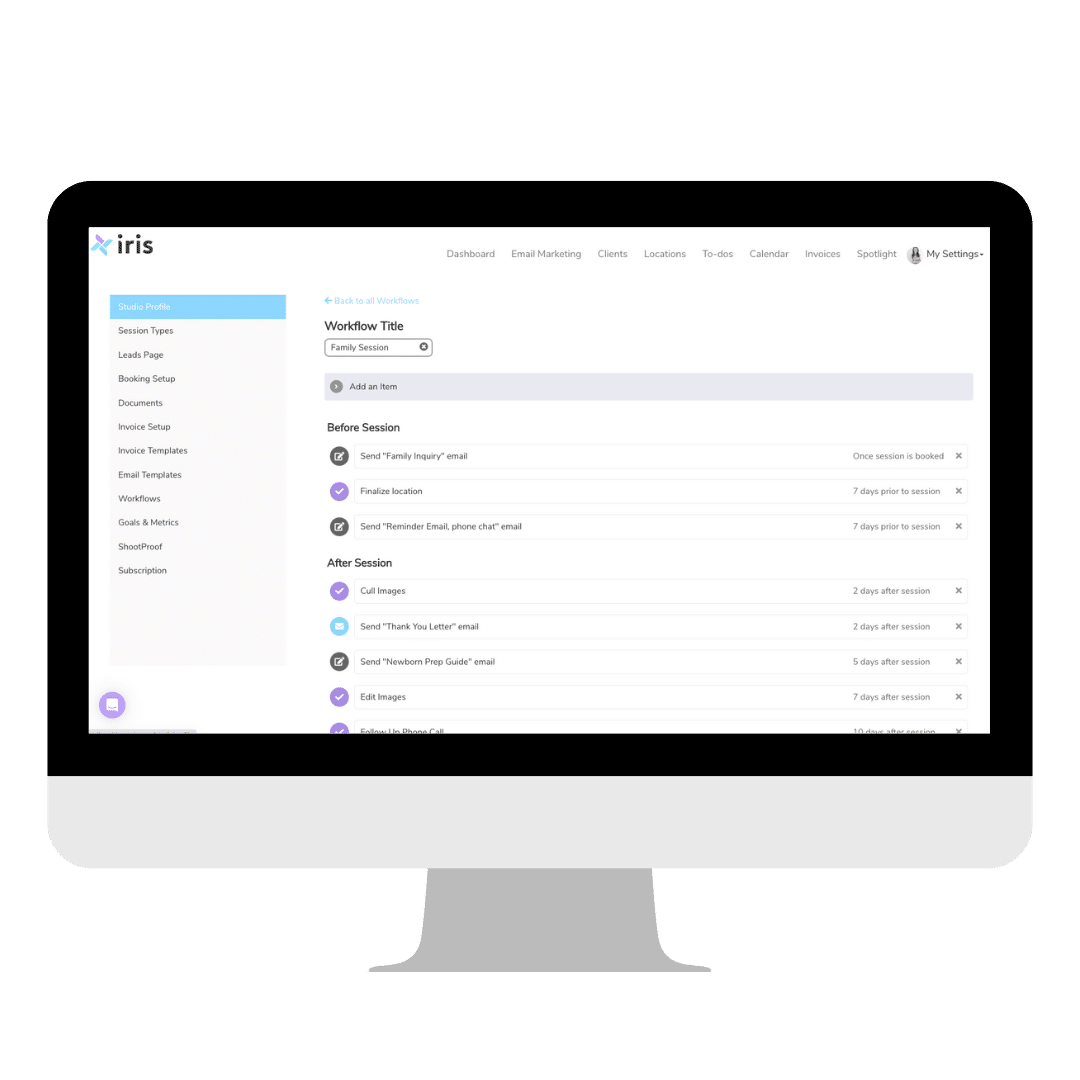
Beyond centralizing information, the strongest session management comes from workflows that move each booking forward automatically. Instead of manually deciding what each client needs next, a workflow assigns the right steps at the right time based on where the session is in its journey.
For example, a portrait session workflow might include an inquiry response, a booking confirmation, a prep email a few days before the shoot, a reminder the day before, and a delivery follow up afterward. Once the workflow is built, every session that enters it receives those steps in order, without you tracking them by hand.
This turns session management from a memory exercise into a repeatable process. Whether you are running three sessions or thirty, each one follows the same reliable path. Nothing depends on you remembering, which means nothing gets forgotten when you are busy shooting or editing.

How Iris Works Keeps Everything Organized
Iris Works was designed to be the central hub photographers need to manage a full calendar. Because it was built specifically for photography businesses, it brings together the exact pieces a session involves rather than forcing you to connect unrelated tools.
With Iris Works, every client and session lives in one place alongside its contracts, invoices, questionnaires, and communication. You can view your calendar, see what stage each session is in, and know instantly what still needs attention. That visibility replaces the mental juggling act with a clear, organized overview.
The platform's workflow automation ties it all together. You can build session workflows that trigger the right communication and tasks automatically, so each booking advances on schedule. As your calendar fills, the system scales with you, keeping every session on track without adding to your workload.
Reducing the Mental Load
One of the most underrated benefits of good session management is the relief it brings. When your system reliably tracks every session, you can put down the constant worry of forgetting something. That mental space is valuable. It lets you be present during shoots, focused during editing, and calmer overall.
The stress of a busy calendar rarely comes from the photography itself. It comes from the administrative weight of managing many moving parts. Removing that weight does not just make your business run better. It makes running your business feel better, which is essential for staying creative and avoiding burnout.
Building a System That Grows With You
The goal of session management is a business that can grow without becoming chaotic. A manual approach limits how many sessions you can handle before quality slips. A systemized approach lets you take on more work while maintaining the same organized, professional experience for every client.
Start by centralizing your client and session information in one place, then build workflows that carry each session through its stages automatically. Once those foundations are set, adding more sessions no longer means adding more stress. The system absorbs the growth.
A well managed calendar is one of the clearest signs of a mature photography business. It tells clients you are reliable, it protects your reputation, and it gives you the freedom to focus on the creative work that drew you to photography in the first place.
Turning Session Data Into Better Decisions
When all of your sessions live in one organized system, you gain something beyond day to day control. You gain visibility into patterns that help you make smarter decisions about your business. Scattered information hides these patterns, but a centralized view brings them into focus.
You can begin to see which types of sessions you book most, how your calendar fills across the year, and where the busy and quiet stretches fall. That insight helps you plan, whether that means adjusting your marketing before a slow season, blocking rest after a heavy stretch, or recognizing which kinds of work are most worth your energy. Managing sessions well is not only about keeping each one on track. It is about understanding the shape of your business as a whole.
This bigger picture is difficult to grasp when your information is fragmented across notes, inboxes, and separate tools. When every session flows through one system, the data accumulates in a form you can actually learn from. Over time, that understanding lets you run your calendar proactively rather than simply reacting to whatever comes next, which is a hallmark of a mature, well managed photography business.
The value of this insight grows the longer you use a single organized system. A few months of centralized session data reveals immediate patterns, but a full year or more reveals the deeper rhythms of your business, including which seasons drive your income, which session types deserve more of your marketing, and where your time is best spent. That perspective is only possible when your information lives in one place long enough to tell a story, and it is one more reason that centralizing your session management pays off well beyond the day to day.
Take the Next Step
Managing many sessions at once does not have to feel overwhelming. With the right system, a full calendar becomes smooth and controlled instead of chaotic. Use Iris Works to centralize your clients, sessions, contracts, and communication in one place while workflows keep every booking on track. See how it works and discover how much calmer a busy calendar can feel when everything lives in one organized system.
Frequently Asked Questions
What is photography session management?
Session management is the process of keeping every booking organized and on track from inquiry through final delivery, especially when handling many sessions at once.
Why does managing multiple sessions get difficult?
The challenge comes from overlap. Different sessions sit at different stages and each needs something different, which is hard to track manually as your calendar fills.
How does Iris Works help manage multiple sessions?
Iris Works centralizes every client, session, contract, invoice, and message in one place and uses workflows to move each session forward automatically.
Can Iris Works show me the status of each session?
Yes. Iris Works lets you see each session's stage, contract status, payment status, and communication history from one organized client record.
Will Iris Works scale as I book more sessions?
Yes. Because workflows run automatically, Iris Works keeps every session on track whether you are handling a few bookings or a full calendar.
Recent posts