


If your business feels scattered, it usually comes back to one thing.
Your workflow is not fully built.
Most photographers do not think about workflow until something starts going wrong. Maybe you forgot to send a prep guide. Maybe a client followed up asking what happens next. Maybe you realized two different clients had completely different experiences without meaning to.
Those moments are not random. They are signs that your process is not structured yet.
When your workflow is undefined, every client requires you to think through each step in real time. That works when you are slow, but as your business grows, it becomes harder to keep everything consistent. You are no longer just taking photos. You are managing communication, scheduling, expectations, and delivery across multiple clients at once.
That is where things start to feel overwhelming.

Why Workflow Matters More as You Grow
When you only have a few clients, your workflow lives in your head.
You know what to send, when to send it, and what needs to happen next. You adjust as you go, and everything still works.
But once your calendar fills, that approach stops working.
You are juggling multiple clients at different stages. One is inquiring, another is booking, another is preparing for a session, and another is waiting on their gallery. Each of those clients needs something different from you at a different time.
Without a clear workflow, you are constantly switching gears and trying to remember what comes next.
That mental load adds up quickly.
Instead of focusing on your work, you are managing details. Instead of feeling in control, you feel like you are catching up.
A defined workflow removes that pressure by giving your business structure.
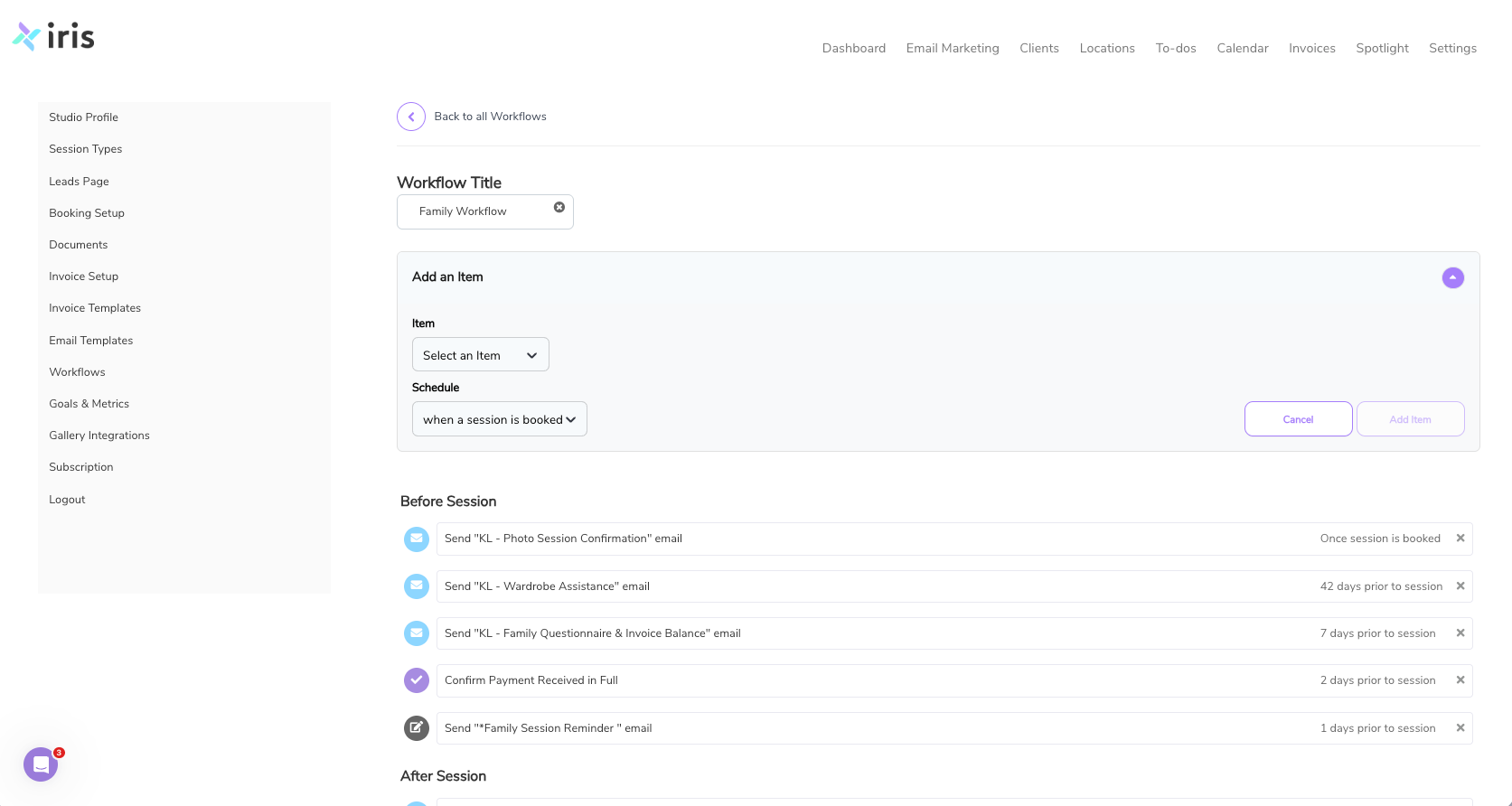
What a Strong Photography Workflow Looks Like
A strong workflow is not complicated. It is clear and repeatable.
Every client moves through the same experience from start to finish. That does not mean every session is identical, but the process behind it is consistent.
From the moment a client inquires, there is a clear next step. When they book, the process continues without gaps. Before the session, they receive the information they need. After the session, communication continues until delivery is complete.
Nothing is left to memory.
This is what makes your business feel organized, both for you and for your clients. They are not wondering what happens next, and you are not trying to figure it out on the fly.
Where Most Workflows Break Down
The reason most workflows fail is not because photographers do not care about organization.
It is because their process has never been fully defined.
Instead of having a structured system, most photographers rely on habits. They respond to emails when they see them. They send contracts when they remember. They follow up when they have time.
That works until it does not.
When things get busy, habits are not enough. Steps get skipped. Communication becomes inconsistent. Clients start asking questions that should have already been answered.
That is when your workflow starts to feel unreliable.
The problem is not your effort. It is that your process is not built to scale.
How a Photography CRM Helps You Build a Real Workflow
A photography CRM takes everything you are currently doing manually and turns it into a structured process.
Instead of handling each client individually, you build a workflow once and let your system run it.
Inside Iris Works, your workflow can be tied to specific actions. When a new inquiry comes in, a response can be sent automatically. When a client books, a workflow can be applied.
Each step is connected.
This removes the guesswork from your process. You are no longer asking yourself what needs to happen next. Your system already knows.
At the same time, everything stays organized in one place. Client information, communication, contracts, and invoices are all connected. You are not switching between tools or searching through emails to piece things together.
What This Looks Like in Practice
When your workflow is built properly, your business runs differently.
A client inquires and receives a response right away. When they decide to move forward, they are guided through booking without confusion. Once booked, they receive everything they need to prepare for their session without having to ask.
As the session approaches, reminders are sent automatically. After the session, your delivery process is already in motion. Follow-up communication happens without being forgotten.
From the client’s perspective, everything feels smooth.
From your perspective, everything feels manageable.
You are not reacting to each step. You are running a process.
Why This Changes How You Run Your Business
When your workflow is structured, your business feels different.
You spend less time thinking about what needs to happen and more time focusing on your work. You are not worried about missing steps or forgetting details.
You are not jumping between tasks trying to keep everything moving.
Instead, your system supports you.
This is what allows you to grow without feeling overwhelmed. More clients do not automatically mean more stress because your workflow is built to handle that growth.
Consistency becomes your default.
Take the Next Step
If your business feels scattered, the solution is not to work harder. It is to build a workflow that supports what you are already doing.
Start by defining your process. Then use Iris Works to turn that process into a system that runs consistently.
That is how you move from managing your business to actually running it.
Frequently Asked Questions
How do I know if my workflow needs improvement?
If you are relying on memory, repeating tasks manually, or feeling like every client process is different, your workflow needs structure.
Do I need to map out my entire workflow at once?
No. Start with one part of your process, such as inquiries or booking, and build from there.
Can a workflow still feel flexible?
Yes. Your process can be consistent while still allowing for customization based on the client or session.
How does a photography CRM like Iris Works improve workflow?
It connects every step of your process, automates repetitive tasks, and keeps everything organized in one place.
How does Iris Works help specifically?
Iris Works allows you to build workflows tied to your client so communication, scheduling, and tasks happen automatically and consistently.
Recent posts