

Email Automation Often Sounds Impersonal — But Clients Experience It Differently
Email automation often sounds impersonal, but clients experience it differently. They experience clarity, reassurance, and timely communication. Those things matter more than who typed the message. Consistency builds trust.
The word "automated" has a reputation problem. It conjures images of generic, obvious boilerplate that makes clients feel like a ticket number rather than a person. And there's a version of email automation that earns that reputation — bulk blasts, obviously templated language, messages that clearly weren't written with any particular client in mind.
But that's not what good email automation looks like in a photography business. Done well, automation is invisible to the client. What they experience is a photographer who communicates clearly, follows up promptly, and never leaves them wondering what happens next. They don't know the message went out automatically. They just know the experience felt professional and reassuring — and that's exactly the point.
Photographers Spend Countless Hours Writing Emails
Most of those emails repeat the same information. The welcome sequence, the session prep guide, the gallery delivery notice, the review request — these go out to every client in some form, and yet most photographers write them from scratch each time, or dig up an old draft and rework it on the fly.
The cumulative cost of that approach is significant. Not just in time, but in the quality of the output. An email written at the end of a long editing session, to a client who needed it two days ago, rarely reflects the level of care and professionalism the photographer actually wants to project. Automating those emails creates breathing room. Breathing room improves creativity — and it improves the emails themselves, because they get written once, thoughtfully, with full attention, rather than quickly, repeatedly, under pressure.
Templates Create Consistency
Email templates ensure every client receives the same information. Nothing is forgotten. Expectations are clear from the start. Clarity prevents confusion.
The practical value of this is easy to underestimate. Without templates, what a client receives depends heavily on what the photographer remembered to include on that particular day. One client gets a detailed prep guide. Another gets a one-liner. A third doesn't hear anything until the day before the shoot.
Those inconsistencies add up to an experience that feels uneven — and at premium price points, uneven feels unprofessional.
Consistent messaging also strengthens your brand voice. When every touchpoint sounds like you — same tone, same warmth, same level of detail — clients develop a clear sense of who they're working with. That predictability is actually reassuring rather than boring. Clients know what to expect. Knowing what to expect reduces anxiety. And reduced anxiety, especially in the lead-up to something as significant as a wedding or a brand shoot, directly improves booking confidence.
Workflows Handle Timing for You
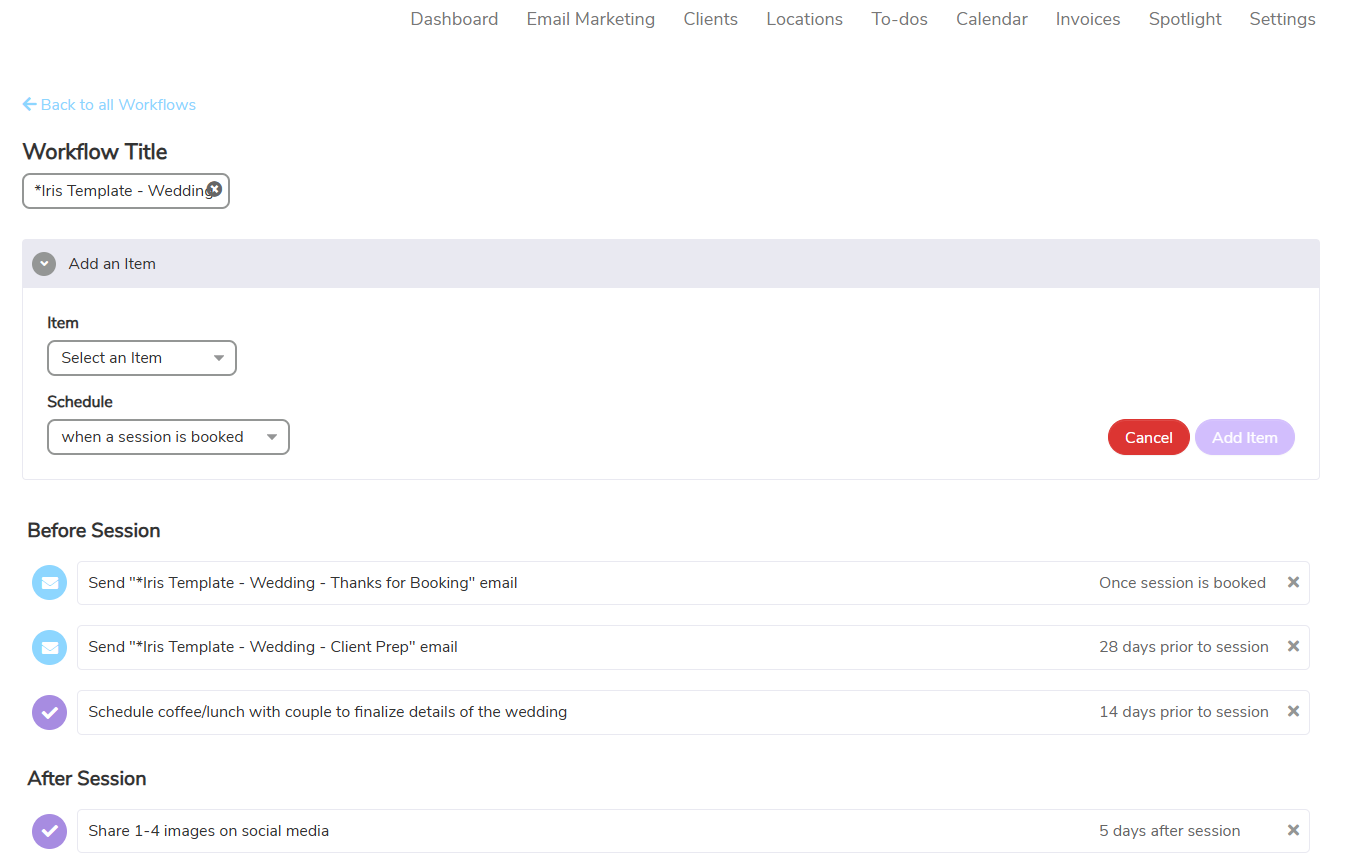
Timing matters just as much as content. Sending the right message at the right moment builds trust. A session reminder that arrives a week late is almost worse than none at all — it signals disorganization rather than care. An email that lands exactly when a client needs it, on the other hand, feels like genuine attentiveness.
The challenge is that perfect timing requires constant vigilance when done manually. You need to remember which clients are coming up, when each touchpoint should go out, and whether you've already sent it. That mental overhead accumulates quickly across a full roster of active clients.
Email automation ensures timing stays consistent without requiring that vigilance. Messages go out automatically, triggered by the right conditions — a booking confirmation, a number of days before or after a shoot, a gallery delivery. Clients feel guided through each stage of the process rather than left to wonder what's happening. Guidance builds confidence, and confident clients are far more likely to move forward, refer others, and come back.
Automation Reduces Mental Load
Remembering who needs what email — and when — is a specific kind of exhausting. It's not difficult, but it's constant. It occupies a persistent corner of your attention that never fully quiets down, even when you're trying to focus on something else.
That mental load adds up quickly across a full client roster. And because it's low-level background noise rather than an obvious task, it's easy to underestimate how much it's actually costing you. The cost shows up in how distracted you feel during shoots. In the slightly slower creative pace when you sit down to edit. In the general sense of things-to-do hovering over everything.
Automation removes that burden. Systems handle the reminders so you don't have to carry them. When your mind isn't juggling the logistics of who needs what, you show up more fully to the interactions that actually matter — the consultation, the shoot, the creative problem-solving. Better presence improves client relationships in ways that no amount of perfectly timed email can replicate. Automation creates the conditions for those better interactions to happen.
How Iris Works Supports Email Automation
Using Iris Works, photographers can build email workflows that run automatically throughout the client journey. Templates are written once and sent at exactly the right moments — inquiry response, booking confirmation, pre-session prep, post-shoot follow-up, gallery delivery, review request. Each one goes out on schedule without any manual trigger.
The experience feels personal because it's consistent and well-crafted, not because it's spontaneous. Clients receive guidance without delay, communication without gaps, and a sense of being genuinely looked after at every stage. That reliability is what builds trust — not the fact that a human hit send.
Clients feel supported. Support builds trust. Trust leads to bookings, referrals, and the kind of long-term client relationships that sustain a photography business over years rather than seasons.
Why Email Automation Improves Client Experience
Clients appreciate knowing what comes next. One of the most common sources of pre-session anxiety — for clients, not photographers — is simply not knowing what to expect. When does the contract come? How do I pay? What should I prepare for? When will I see the photos? These are reasonable questions, and when they go unanswered, they create friction that doesn't need to exist.
Email automation provides that reassurance proactively. The information arrives before the client has to ask for it, which signals organization and care. Reassurance reduces uncertainty. Reduced uncertainty leads to action — to signing the contract, completing the questionnaire, making the payment, and showing up to the shoot relaxed and ready.
When communication feels smooth, clients relax. Relaxed clients bring better energy to sessions. They're more open, more present, and more enjoyable to work with — which produces better images, which produces happier clients. Everyone benefits, and it all starts with a system that handles communication consistently.
Frequently Asked Questions
Will clients be able to tell my emails are automated?
Not if the content is written thoughtfully. What clients notice is whether the communication feels relevant, warm, and timely — not whether a human pressed send. An automated email that arrives at exactly the right moment, in a voice that sounds like you, and addresses exactly what the client needs to know at that stage will feel more personal than a manually written one that arrives late or forgets key details.
What's the difference between an email template and an email workflow?
A template is the content — the written message for a specific touchpoint, like a welcome email or a session reminder. A workflow is the logic that determines when that template gets sent: which trigger fires it, how many days before or after an event it goes out, and what conditions need to be true. Together, templates and workflows create a system where the right message goes to the right client at the right time, automatically.
Which emails in a photography business are the best candidates for automation
Any email that every client receives in roughly the same form is worth automating. The most impactful tend to be: the initial inquiry response (where speed is critical), the booking confirmation with next steps, the pre-session prep guide, the 48-hour reminder, the post-shoot thank you, the gallery delivery notification, and the review request. These touchpoints happen identically for every client and benefit enormously from consistent, timely delivery.
What happens if a client's situation doesn't fit the standard automated flow?
Automation handles the standard touchpoints; you handle the exceptions. Most of the communication in a photography client journey is predictable enough to automate. When something unusual comes up — a rescheduled shoot, a special request, a concern that needs a human response — you step in. The system takes care of the routine so your attention is available for the moments that genuinely need it.
Does email automation work the same way for different photography niches?
The triggers and content will vary, but the principle applies across every niche. A commercial photographer's workflow might focus on brief turnarounds and usage rights reminders; a wedding photographer's might center on multi-month nurture sequences and vendor coordination; a family portrait studio's might revolve around seasonal campaigns and repeat booking follow-ups. The specific emails are different, but the benefit — consistent, timely, effortless communication — is the same.
How much time does setting up email automation actually take upfront?
Writing and setting up a complete client email workflow typically takes a few hours — less time than most photographers spend writing the same emails manually over the course of a single busy month. The upfront investment pays back immediately and continues compounding with every future client. Most photographers who set up automation describe it as one of the highest-return things they've done for their business, precisely because the effort is one-time and the benefit is ongoing.
Recent posts